architecture

midwestern bridges

steel bridge 03

steel bridge 03

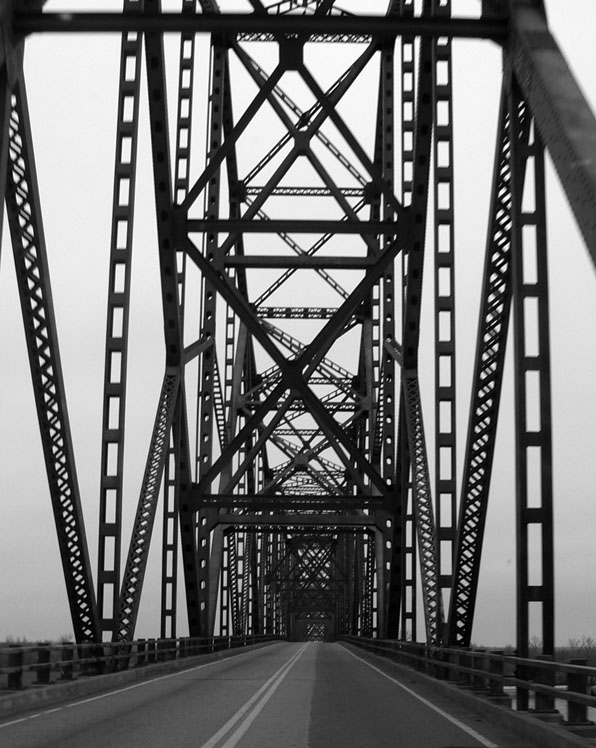
Before interstate engineers replaced our river crossings with solid, straight, under-supported super-slabs of concrete highways, spidery steel bridges carried us across the impediments to the relentless to- and fro- of an increasingly mobile society.

steel bridge 01

steel bridge 01

When you pass through the steel rib cages of these older bridges, especially the narrow, long spans, crossing a river feels like a celebration, an exciting transformation from one place to the next.  The uniformity of road surface, side rails and driving surface of concrete pier bridges celebrate only the efficiency of travel, not the journey.
steel bridge 02

steel bridge 02

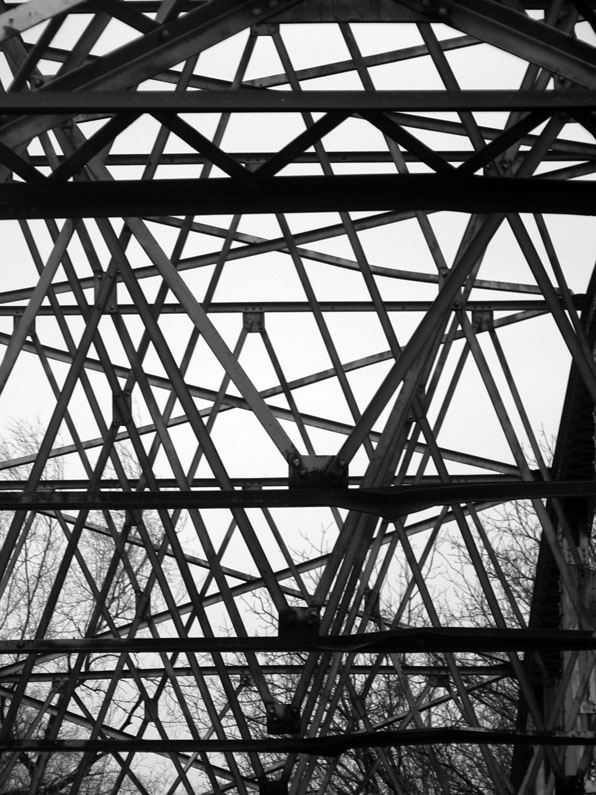
These bridges make a space amongst themselves, an interstitial place between here and over-there.  Because the structure of the bridge is above you and around you, you don't simple glide across a river or steep valley, but you feel the suspension from gravity of that leap across space.
the long house

by right envelope with demo

by right envelope with demo

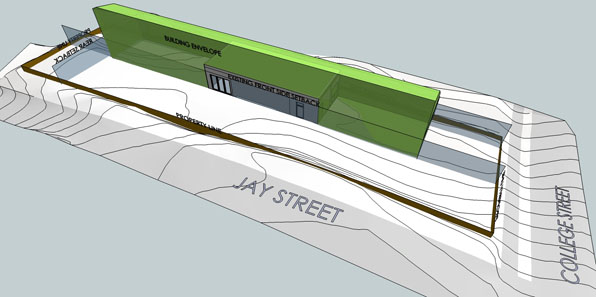
We have been working on a project in Boulder that holds a number of challenges, not the least of which is a long narrow lot with severe building restrictions.  My client's property is 50' wide by 188' long, but because of its corner location, both street-facing sides of the lot require a 25' wide setback from the street.  That setback along with additional side and rear yard setbacks makes the building envelope 20' wide by 128' long, a 6 1/2 : 1 length to width ratio.  A potential upper level is even more restricted by a solar shadow ordinance making the available building envelope up there an amazing 9' wide by 128' long or 14 : 1 ratio.

I have developed some long, narrow projects in the past.

The Cornhouse project was a speculative effort for a long, narrow house nestled within the parallel, seemingly endless rows of corn that one sees in the upper midwest.  Driving between where I lived, Chicago, and where I grew up, Kentucky, I would pass through hundreds of miles of Indiana corn fields, their arrow-straight rows creating a pulsing rhythm looking down their long furrows.  Fundamental to the design of this house project was its position among the corn and the changing relationship to the horizon that occurred as seasonal corn grew from the damp ground to its late summer height well over the heads of the inhabitants.  Equally present in the scheme was also the narrow layout of the house based on the typical 22" module of corn furrows.

Cornhouse 01

Cornhouse 01

Cornhouse 02

Cornhouse 02

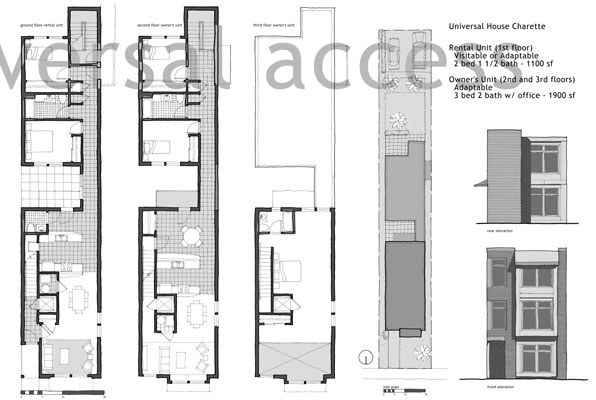
That long narrow Cornhouse has its urban twin in a competition design executed a few years later.  Where the cornhouse was long and narrow in an expansive landscape, the layout of the city house was dictated by the long, narrow property lot boundaries of Chicago's Lawndale neighborhood.  Designed for a tough, urban setting and for universally accessible use, this long house was internally focused, centering around a courtyard space and incorporating two units, distributed over the building's three levels.

Chicago competition

Chicago competition

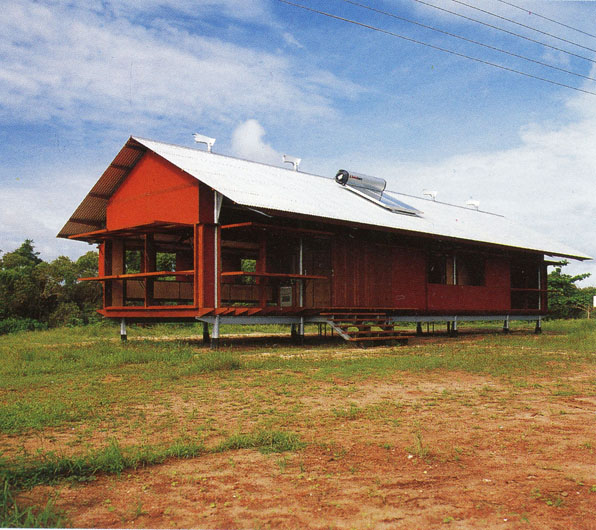
I have written in the past about the unconventional massing of these kind of long and narrow buildings and the jokingly absurd Hyper-Attenuated Building Syndrome. A brief study of the work of Pritzker-prize winning architect Glen Murcutt reveals more than a few quite extraordinary long and narrow building designs.  These works, especially the houses, seem to slowly reel themselves out, room after room unfolding as you progress through the house.

Murcutt 01

Murcutt 01

Our current project's history is marked by our initial attempt to make a smaller more compact house that substituted height for length.  After an anguished meeting with neighbors stridently objecting to the potential loss of views because of the proposed height, we may be shifting back to the long house.  I'm not sure if this kind of elongated house will be more or less opposed by the neighbors, but given the strictures imposed by the setbacks, we have only two ways to go - tall and more compact or the stretched out massing of the long house.

small town movie theatres

movie theatre 01

movie theatre 01

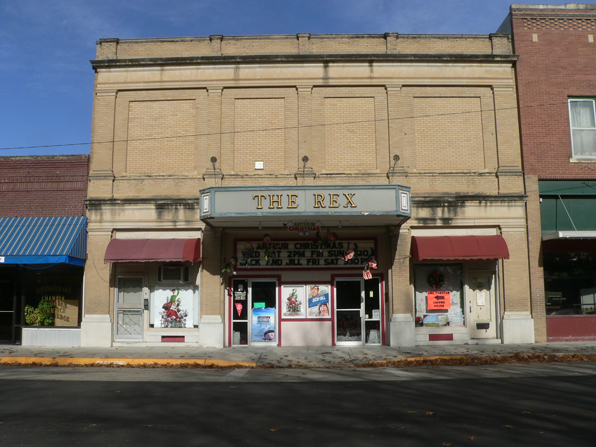
Most of the smaller towns that I passed through on a recent road trip had their version of the local movie palace.  And most were closed down along with the rest of the storefronts along the main street.   The emptiness of middle America is remarkable and so sad.  We all hear the statistics about the growth of the larger cities and the gradual emigration away from small towns.  But something about the desolate marque of the old movie theatre strikes me as the most melancholy of the all the main street ghosts.

movie theatre 03

movie theatre 03

You can almost see and hear the activity of the crowd out front, the ticket sellers booth and the couples lingering after the show.

movie theatre 02

movie theatre 02

These buildings were also the real stars of the main street.  They were fantastical and showy, brash and sometimes clownish in their attempts to draw our attention, and all the more so when standing next to the somber drugstore and barbershop.

movie theatre 04

movie theatre 04

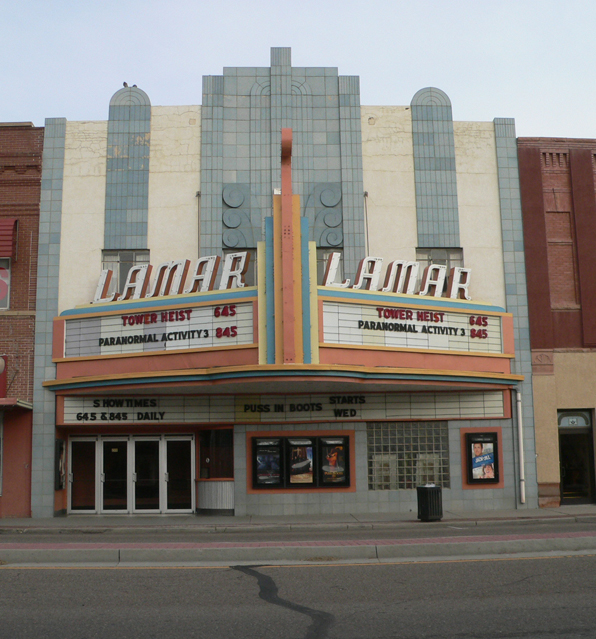
Some are still open of course.  I would have loved to have seen a show at the eponymous theater in Lamar, Colorado on the eastern plains.  Any movie in that place gets an extra star.

the Flyover

flyover01

flyover01

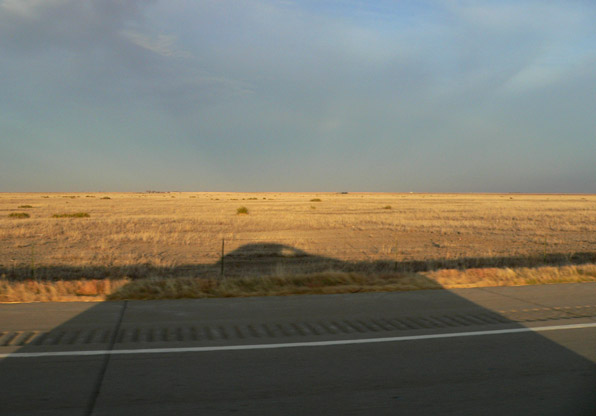
Over the recent Thanksgiving holiday break I took a roadtrip from Colorado to my native Kentucky.  This is the vast Flyover land of the center of the United States.  It is roughly the former vast inland sea from the Rocky Mountains to the Appalachian Mountains.  It is certainly the least densely populated one third to one half of the the US, and largely dominated by fields and pasture, sheds and barns, farmhouses and shacks of agricultural America.

This immense area - eastern Colorado, Oklahoma, Kansas, Missouri, Illinois, Indiana, Iowa, western Kentucky - is not the stuff of dramatic landscapes.  That is not to say that it is not beautiful, but it is a softer, more subtle set of relationships between land and sky that makes this area's initial uniformity peel away to reveal an intensely beautiful sense of place.  And in that flat, or gently rolling landscape, a building sticking up from the earth holds a kind of power that qualifies the space around it.  A sense of space aggregates around a building.  Here in the Rocky Mountains and in so many places along the eastern seaboard, there seems to be a natural space that buildings have been placed within.  But in these midwestern plains, a building makes a space, a small domesticated sphere that comes into being only by the nature of the building.

flyover02

flyover02

Frank Lloyd Wright knew this.  He clearly understood how a building sits on this flat earth and how a large, sheltering roof can make a space more profound than a series of walls.  On my recent trip I did not visit any of his iconic prairie-style houses, but rather the Price Tower in Oklahoma.  More about that in an upcoming post.

Driving for many hours is a great way to reflect on things, and for me this naturally falls to things architectural.  Over the next few weeks I will post some more photos and thoughts that bubbled up during this long drive.  Send me your thoughts.

First Christian Church, Boulder, Colorado

First Christian 01

First Christian 01

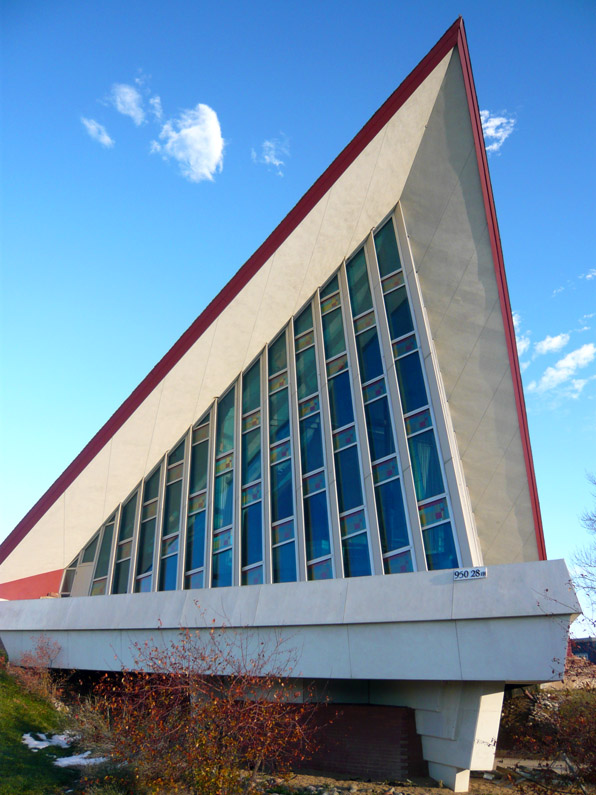
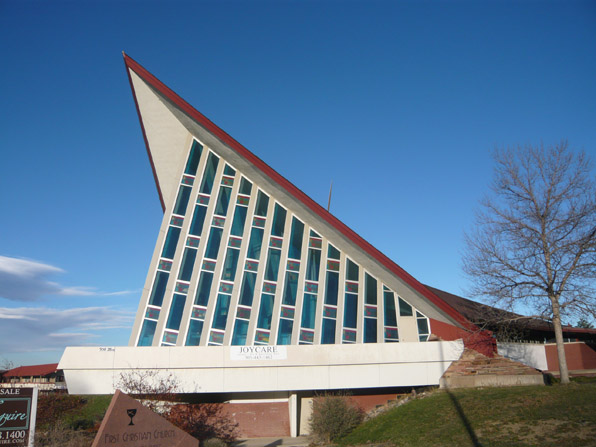
As almost anyone can attest to, one of the very first buildings that most people see on arriving in Boulder is the First Christian Church on CO 36/28th Street, in southeast Boulder.

Built in 1960 and designed by Nixon and Jones, it is an excellent introduction to Boulder's great collection of late Modernist architecture.

The main sanctuary is the west-projecting prow that mimics the angled flatirons on the horizon and is clad in long strips of blue glass with a decorative, multi-colored geometric motif.  The dropping site grade accentuates the projecting prow and the long, white horizontal balcony acts like a visual cantilevered beam simultaneously anchoring the building to the ground and allowing for it to soar upward.

First Christian 06

First Christian 06

Alongside the form of the sanctuary space is a stark brick "campanile", lozenge-shaped, standing just to the east of the main entry.  While I don't think this tower houses any bells, it does act as that typical vertical element of the traditional campanile, distinguishing the entry and providing a vertical counter to the horizontal impetus of the front of the building.

First Christian 03

First Christian 03

The east side of the building is a series of low, single-story structures, an office and school.  But the heart of the building clearly lies in the west sloping face.

First Christian 02

First Christian 02

The sanctuary portion of the building has been empty for quite a few years and is suffering from some much needed delayed maintenance.  The soffits are showing some damage and the brick, with its raked horizontal joints and flush vertical joints, so typical of Wright-inspired mid-century architecture, is in need of proper tuck-pointing.

First Christian 05

First Christian 05

There are development plans afoot for much of the site, including some demolition, but retaining the sanctuary and campanile.  As First Christian sits along the most-traveled entry into Boulder, thousands of folks travel past it everyday without much of a thought.  Certainly the sites around this church have sprouted many buildings of ever-increasing size and articulation, diminishing the impact of the work.  Nevertheless, it would be difficult to imagine Boulder without this iconic, welcoming edifice.

First Christian 04

First Christian 04

new construction in Dakota Ridge, north Boulder

MT colored west elevation

MT colored west elevation

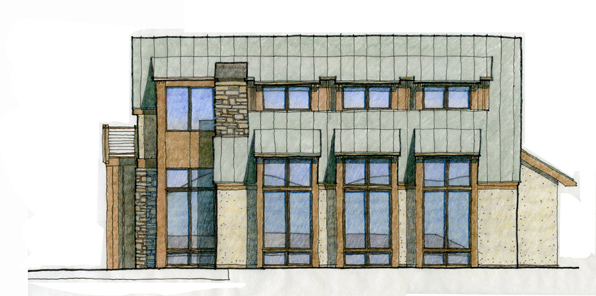
We are just getting ready to start construction on a new house in the Dakota Ridge Village neighborhood of north Boulder.  The project is a design/build collaboration with Cottonwood Custom Builders with whom we have executed a number of past projects.

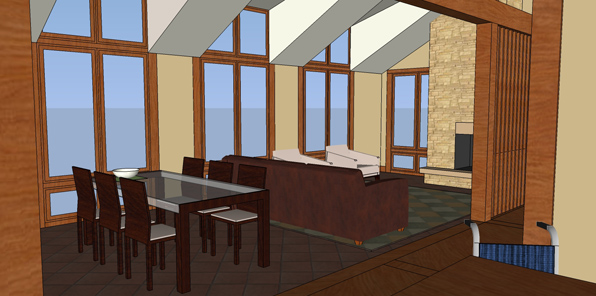
The house consists of an extensive main level which houses all the primary functions of the house as well as the master bedroom for a barrier-free design.  This necessary horizontal datum of the floor is offset by a series of interrelated vertical spaces linking the main level to the other floors of the house.  These vertical spaces generated a tall, narrow proportion that is reflected on the exterior of the building, creating dormers and projections that articulate the building while still adhering to the homeowners association's guidelines.

site plan

site plan

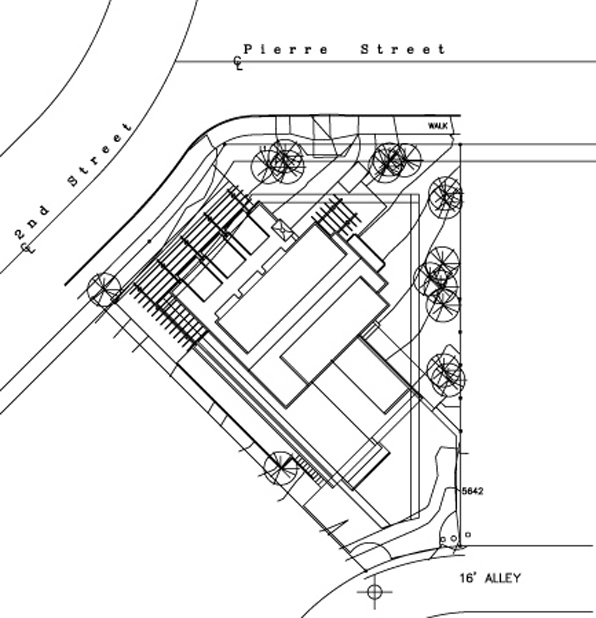
The property is an unusual corner situation with the corner spanning approximately 135 degrees instead of the usual right angle relationship.  This flaring of the site luckily corresponds with the view opening up from the rear of the property's densely populated alley condition to the west edge facing the rolling undulations of the Boulder foothills.  This span across the site from alley to street also has a fairly consistent slope, rising 10 feet from back to front.

MT model figure ground

MT model figure ground

Pending the receipt of our building permit, we are finalizing budgets and finishes and are looking forward to executing another project with the folks over at Cottonwood Custom Builders.  Designing buildings is fun and inspirational, but pales in comparison to the real event - making a building.

MT interior revised 04

MT interior revised 04