architecture

man space

pool-hall-1913-s

pool-hall-1913-s

The title of this post is not an allusion to a gay bar in Chicago, although I do think there was one with that name.  Rather, I have written in the past about the growing prevalence of and interest in gender specific 'guy spaces'.  I am not an academic and I am wary of stepping into such a dangerous landscape as gendered space, but by coincidence or not, I have been engaged on a couple of projects recently that press the question of male-dominated spaces.

I should say that these are not really "male-dominated" because they are actually male-exclusive places.  One is a fraternal organization, the other is a generations-old hunting club.  Both have that smell of leather and old wood and the unmistakable look of domestic neglect that are tragically stereotypical but abundantly manifest.

Travelers Club London Smoking Room by csabagaba

Travelers Club London Smoking Room by csabagaba

I have worked for a number of different types of clients for a variety of project types.  As most of my work recently is involved with single-family houses, the majority of clients have been female-male, married couples.  Some have children, some not, some couples are near retiring with adult children, a remarkable number of clients have children during or immediately after construction.  I have had plenty of single clients and recently a number of female-female couples as clients.   In all these cases there have not been any easy patterns or identifiable mechanisms by which you can predict how the interaction of decision-making will take place.  The cultural prejudice has the woman making the aesthetic decisions while the man handles the finances and "functional" issues.  As an architect, that has not been my experience at all, and as a single, hetero-sexual guy with kids, I have empathy with anyone that puts their trust in me to make them a home.  Any attempt to delineate these issues with regard to gender, sexual orientation, age, marital status, etc. would have been impossible.  With maybe one exception.
Berghoff, Chicago

Berghoff, Chicago

Guys seem really embarrassed to say how much they care about how things looks.  They flee from the aesthetic realm with a surprising zeal.  Of course this is not always the case, but as a guy who spends my days and nights designing things, this seems odd and a bit disorienting.  And when your client is a bunch of guys, the owners of a club for instance, and someone has to make design decisions, this can be frustrating.  No one wants to really own these decisions, to strongly come down on the side of sage green in lieu of celadon, or vernacular versus traditional.  A guess it all sounds and feels a bit too fluffy, too close to aprons and doilies and pom-poms for many guys to feel comfortable.

Sorrento mens club, by Lorayn DeLuca

Sorrento mens club, by Lorayn DeLuca

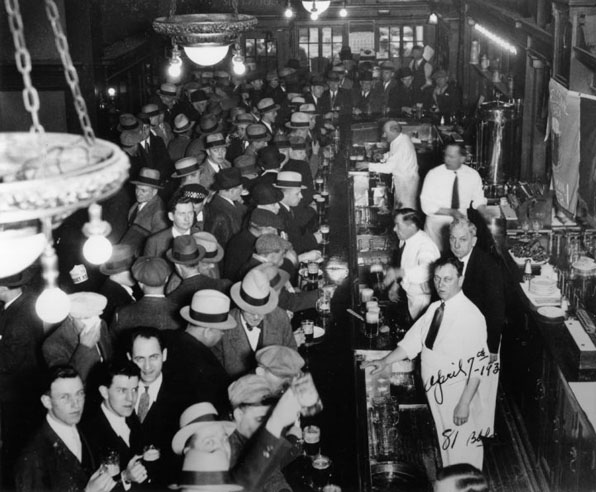
As a result, I have been collecting images of traditional guy spaces that I can show to this kind of reluctant client.  I think it is much easier for them to see an image and say, "yeah, like that", than to talk through the particularities of each material or color and even more elusive quarry like room-feel and atmosphere.  Many of these are old photos, of places long since past:  barrooms and pool halls, club rooms or military institutions.  There is more nostalgia dripping from these images than in any of the countless of magazine photos that other clients send me.  I know it is too simplistic to say it is nostalgia for a by-gone era when men unquestionably and unapologetically ruled the kingdom.  There is clearly a remisniscence of fathers in these places, for fathers maybe more imagined than realised.  You can almost smell the acqua velva, old spice and brill cream mingled with smoke and whiskey.  There is certainly some recognition of these places on my part and that may largely explain my growing collection.  But as a design tool, these photos are invaluable.  And I would never have guessed, back when I was a eager architecture student, that one day I would have a binder in my studio labeled "MEN'S ROOMS".

Pendennis club, grill, 1928

Pendennis club, grill, 1928

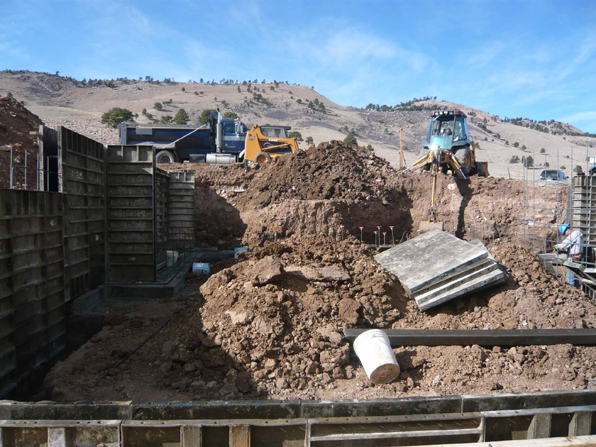
Dakota Ridge Village house, construction progress

Construction is well under way on a single family house we designed for a site in north Boulder.  The lot is on the edge of the city's open space facing west to a series of rolling foothills.  As a corner lot, the house's views are primarily directed toward this westward view with some smaller, more discrete views to the south and east.

As far as the construction progress is concerned, this project started like many with an accurate layout of the house on the property.  Obviously we have figured this all out in the design stages many months ago, but it is always instructive to see the placement stakes on the land itself.  Those simple little stakes lead the way for some heavy-duty work:

Excavation can be a tricky business.  We have a soils report that we rely on to tell us the profile of the subsurface conditions including bedrock and water table issues.  However, only when equipment is actually rolling do we get to see the actual conditions and often have to make revisions on the fly to accommodate conditions or take advantage of opportunities that arise.  In the case of this house, the soil conditions for supporting the house were deeper than originally anticipated so we had to dig a bit further and create taller foundation walls.  Our contractor realized immediately that this deeper foundation could result in more full-depth basement space and less crawlspace.  So after a quick conference with contractor, owner and architect ...

Well, we're still working on it.  The proposed change looks like it makes sense and the cost is not too formidable.  So, while the concrete foundation walls are being poured and slowly coming up to full strength, a lot of phone calls are made, calculators worn down and potential changes are weighed and reconsidered.

It is simple to say that we should just make a really complete and thorough set of drawings and turn them over to a contractor to execute.  In my twenty or so years of experience there is no substitute for being fully involved in the construction process as a reliable partner to the contractor and owner in helping solve issues that inevitably bubble up.  Architects, if you think your drawings alone will get you a good building made, I am afraid you are solely mistaken.  It is the relationships you develop on the jobsite, with your client and with the inspectors, reviewers and every single tradesperson that will result in a building you can truly be proud of.

So the best marker of construction progress is not so much a series of photos or payout requests, but the growing trust and belief in the team itself to execute not just a set of drawings, but a shared vision of a project, a building and a home.

Architecture in Crisis

I try not to have this little blog be a mere reposting of other's content or the latest eye-candy images of buildings (archi-porn), but rather to try to add something, maybe feeble, to the dialog about making, architecture and place.  However, occasionally a really interesting article or topic comes to my attention and begs for attention.  Such is the case with Salon.com's Art in Crisis piece by Scott Timberg highlighting the truly dreadful state of architecture as a profession over the last few years. Living in Boulder and having low overhead and a punishing work-schedule has insulated me from much of the economic disaster of the last number of years.  This is the fifth year of M. Gerwing Architects and I have been truly blessed with enough good clients and intriguing projects to both keep my spirits up and keep the doors open during the worst possible time to start an architecture practice since the Great Depression.  But I know that I am the exception and even in my fortune I am only a project or two away from dissolution.

I have written in past about the recession and its impacts on architects, especially the lost generation of younger architects.  In doing so I have been incredibly frustrated and incensed that the American Institute for Architects does not track unemployment in our own profession.  Timberg calls it right when he accuses the AIA of polly-anna-ish optimism at best and downright incompetence in my opinion.

At the risk of being the kill-joy, I urge you to read the best piece of the recession and the plight of architects and architecture, Scott Timberg's Art in Crisis.

(image from the same article, John Nazca, Reuters)


Haertling's Menkick House for sale

Menkick House 02

Menkick House 02

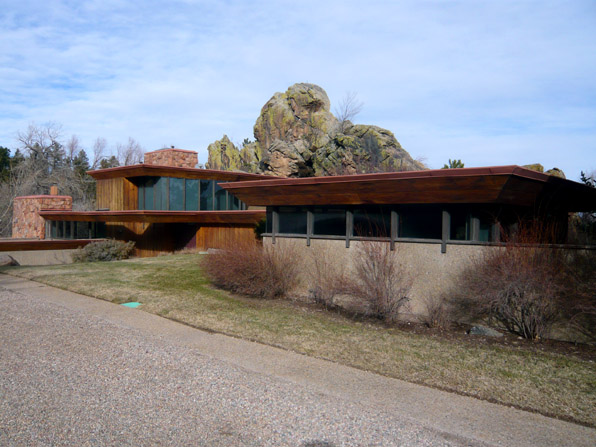
An astute client pointed out that the magnificent house on Green Rock Drive, the Menkick House, by Charles Haertling, is up for sale.

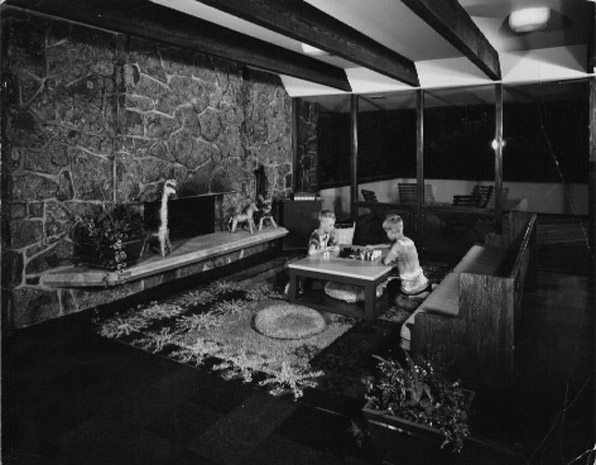
Completed in 1970, the Menkick House is among Haertling's finest works and ranks alongside his Volsky House, Benton House and Willard House as one of the finest examples of late Modernist Organic architecture in the United States.  Placed against a large, vertical rock outcrop, the Menkick House dramatically highlights this with its expressive horizontal emphasis.  Heartling wisely located much of the plan of the house on a lower level so that the overall size of the house does not overpower the presence of the rock and from the street a great balance is achieved.

Menkick interior 01

Menkick interior 01

Menkick plan

Menkick plan

The plan and building form are reminiscent of Frank Lloyd Wright's Usonian work in the middle period of his career and the house's use of the large rock outcrop is a vague allusion to Wright's similar use in Fallingwater.  However, Haertling's house sits rather comfortably within a relatively dense suburban neighborhood on the edge of the foothills.  It is difficult to imagine Fallingwater with any adjacent structures and in fact the later guest house designed by Wright does seem to crowd the expansive plan of the original house.

Menkick House 01

Menkick House 01

Menkick aerial

Menkick aerial

One can only hope that the new owners will treat the house with the respect it is due.  As the building sits in Boulder County, just outside of city limits, it does not come under the potential protection of the city's Landmarks Board.  The County's record of preserving Haertling's work is a bit blemished with the allowed demolition of the albeit much compromised house in Eldorado Springs designed by Haertling and Tician Papachristou.

From the street, the house looks to be in excellent condition and I know some work has been done on the interior over the years.  Someone will get to own a really great piece of not only Boulder history, but one of the finest houses of its era in the United States.

Some photos 'borrowed' from the great website on Haertling, Atomix, and ModMidMod.

up Sunshine Canyon, construction progress, The Home Stretch

SZ lr01

SZ lr01

Over the last several months I  have posted images of the construction progress for a house we designed up on Sunshine Canyon, just west of Boulder.  The original house at this location was lost to the Fourmile Fire in September 2010 along with 170 other houses.

We are in the last 4-6 weeks of construction, with all the finishes coming into place - painting, tile, carpet, hanging electrical fixtures, etc.  This is usually the most anxious time for homeowners as the final design comes significantly closer each day with every new tile, cabinet and countertop.  However, though it may look like move-in can occur any day now, it still takes some 4 weeks or so to complete these final tasks.  From this point on, almost every thing on the project is absolutely sequential.  Each trade, from painters to cabinet installers, needs complete unhindered access to each room and they must complete their work before the next trade can come in.  This can be very frustrating for homeowners as they are so anxious to finally get done with the construction but there are not that many folks on the jobsite.

SZ stone 01

SZ stone 01

The final task, the Punch List, is my job and hopefully takes place without the owner's boxes filling up the rooms.

The Punch List is an exhaustive, room-by-room review of everything on the project.  I review every wall for defects, the ceilings, floors, trim, doors, etc. until we can get a complete picture of all of the final touch-ups that need to be completed.  Every sink is turned on and off, windows opened and closed, all systems run on and off.  In the end this results in a multi-page document that is the Punch List that the general contractor will have to complete.  For a good contractor this document can be short, running 4-5 items per room.  A contractor rushing to finish a project can easily make a Punch List expand to 20-25 items per room.  It usually takes me a full day to complete a Punch List and to keep us focused on every detail I typically request a day when no work is being done, no movers, no tradespeople, on owners.

SZ lr02

SZ lr02

I'll post again when we get to the Punch List and talk a bit about expectations of completing that list in a timely fashion.