info for home-making

Universal access and aging-in-place

Maybe it is just a coincidence, but I are finding that I am working on a number of projects that deploy universal access principles as a major part of the design process.  If you are not familiar with this term, universal access is an outgrowth of the barrier-free design guidelines that we were all using for public buildings just a few years ago.  The idea of universal access however encompasses not just guidelines for wheelchair users, but recognizes that curb cuts aren't just necessary for them, but aide folks with strollers and kids with skateboards.  It is an acknowledgement that we all age and designing to accommodate the needs of the many probably  benefits us all at some time as individuals.

My father has serious mobility issues and my sister and I have spent an increasing amount of time over the last few years trying to reconfigure and adapt his typical suburban house to his needs.  After a broken hip, we quickly realized that the door to the master bath, a door he has used for over 25 years, is now 2" too narrow to allow a walker to slide through.  The shower in that same bath is too narrow to allow a seat to easily fit and the handle of the shower door is too easily confused with a grab bar.  Same with all the towel bars.  The laundry downstairs has been abandoned as has the back entrance, which although it is almost at grade level, has an absurdly slippery deck that no amount of friction tape seems to ameliorate.

These are good lessons for an architect.  We are all adept at designing to codes and the guidelines of the Americans With Disabilities Act.  But the actual, everyday experience of seeing my father trying to navigate the kitchen has taught me so much more.  And rarely have architects applied these universal design principles to single-family houses for aging-in-place prospects.  I am currently working on a project that is a father-in-law suite that subtly incorporates universal design principles.  It looks clean and simple and elegant and is also going to be a great asset to his daily living.  At the same time, we are engaged in the early stages of two projects that directly confront the needs and desires of wheelchairs users.  Seeing the house from that point of view, both actual and metaphorical, is a fascinating challenge and it reframes the poetic possibilities of every part of the house that we so easily overlook.

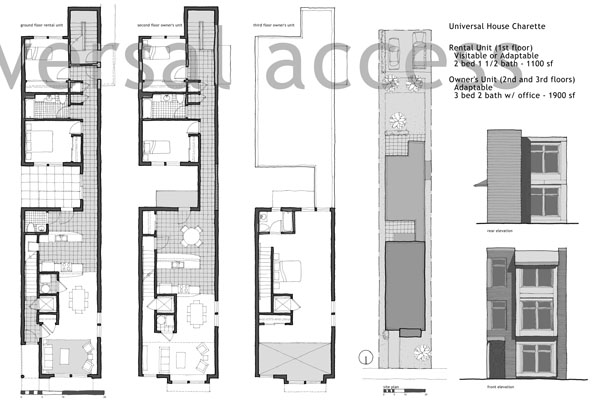
A pair of design presentation boards we did for an urban universal design competition for a neighborhood in Chicago from 2005:

live – work

In the past few years I have had the opportunity to work on a number of projects that fully incorporated a live-work dynamic as a fundamental part of the house.  More than simply a home office, a fully-utilized live-work program creates a kind of tension of use and privacy that most homes in the last one hundred years or so have not encountered.

Most of the projects like this that we have worked on included a single large office or studio.  And the variety of work has differed greatly but all with one similar aspect - the ability, via computers and the internet, to communicate visually, verbally and to a great degree of satisfaction - with a remote office or clients.  Rarely do these home offices or studios include a separate entry for clients or employees because the work in question does not require it.  More often, my clients work at home and take the drive to the airport on a regular and frequent schedule to meet with their clients and co-workers.

So what is the nature then of these home offices?  They are not the 19th century gentlemen's study, a place of retreat and contemplation.  They are wired and connected not just functionally, but also culturally, to distant places and all to the landscape that is the internet.  More trips are taken to Google than the local coffee shop.  What is the nature of "privacy" in a space in your house that is open to so much of the world with the only "threshold" of a keyboard and/of mouse?

In looking at these projects and working on some current live-work projects, what occurs to me is that in each project we have tried to ritualize the passage in the house from the working space back and forth to the rest of the house.  In the images above, for a condo renovation, the office was on a half-level between the main level living spaces and the upper floor master bedroom.  We focused effort on the stair and tried to create a unique space, with light streaming down from skylights, to set this passage off from the more conventionally proportioned rooms.  In addition, we installed a series of semi-transparent resin panels on both sides of the stair to modulate the sound and views from the office to the rest of the house.  The public-private dialogue that takes place across this stair makes a kind of liminal threshold that makes the mental shift to and from "working".

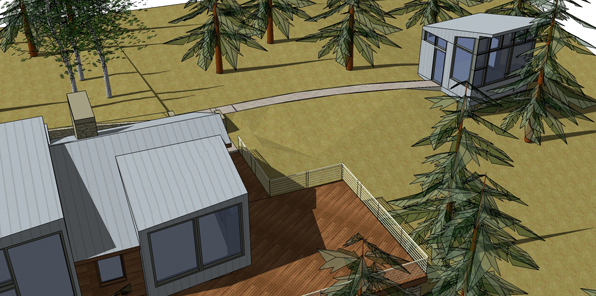
In the project above, we designed a simple writer's shack as an additional outbuilding to a cabin renovation in rural Colorado.  The shifted geometry of the writer's shack reverberates back through the cabin as series of new dormers, inserting the "working" within the "living".  And again, the path between the buildings, a simple path through the woods, is designed as a careful separation - just far apart for a sense of separation, but not too isolating.  That ritual of walking between the two, with a cup of coffee in hand, boots on but not laced up, the pupils adjusting to and from the bright, Colorado high-alpine sunshine, makes each building a distinct place, the occupation intentional.

The image above is a home office we designed, very warm and internalized, that looks out to a mountain vista.  This is a built analogue of the relationship of the home-based office, secure and private, looking out via the internet, to the rest of the electronic world.

I'm not sure how the issues of the private office and the public connectivity play out for a project - that relationship varies with each client and each space.  I do know however that just putting a desk in an unused bedroom does not really address the live-work issue and forsakes a potentially rich landscape of ideas and use that is architecture.

the new small house – or maybe not quite

There is a ton of press on the new small house phenomenom.  As a response to the excesses of consumption and the economic turmoil of the last few years, many architects, builders and inventors have created amazingly livable micro-houses.

I was listening to an interview with one of these tiny house makers and he was mentioning that with technology, we can compress hundreds, thousands of albums and CDs into a single Ipod.  And the same with books - eliminating them saves hundreds of square feet.

This sounded absurd to me at first until I took a more careful look around our house.

For some, the compression of many hundreds of books into a single, tiny disc is a revelation.  However, I must admit that my books mean a lot more to me than the words inside them.  I have lived in a few cities, moved many times.  But the constant of books has given great solace to that kind of displacement.  Looking at one's various bookshelves is like looking at a kind of biography of self.

If you get the opportunity, I would strongly recommend Walter Benjamin's essay Unpacking My Library in his collection entitled Illuminations.

So, while I would encourage everyone considering making a new house to reduce their assumptions of the size "required", I am too guilty of a kind of hoarding fetish when it comes to books.  A micro-house may be the goal, but our impediments of self require considerably more than focusing a microscope on need and function and making that the totality of a house.  That difference, between our needs and our wants, makes the ground for making architecture.