Frank Lloyd Wright's Meyer May House, Grand Rapids, Michigan

This last summer I had the opportunity to be in Grand Rapids, Michigan, home of Steelcase furniture, and the magnificently restored Meyer May house.  Designed by Frank Lloyd Wright in 1909, the house was designed and built just as Wright's marriage was falling apart and he was soon to depart to Europe to escape the scandal and notoriety.

Like the Robie House, designed in Chicago just a year or two earlier, this house sits on a residential corner lot and shares with as well Wright's signature hidden entryway and layered horizontal composition.  Even though the Robie House is more dramatic, being more decidedly long and narrow, the Meyer May house actually does a better job of addressing the spatial situation of the corner lot.  However, this does lead to a fairly complex interior with spaces driving in two directions, maybe anticipating the more pinwheeling designs of later houses.
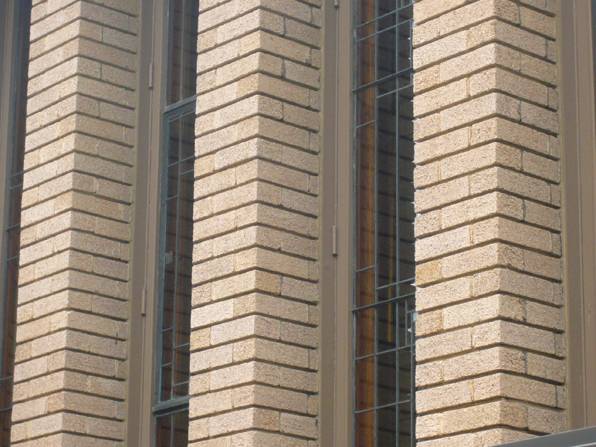
You can see many of the typical Wright details here - the flush vertical joints and deeply scored horizontal joints of the masonry, the wide cantilevered, hovering roof planes, the delicate leaded windows.
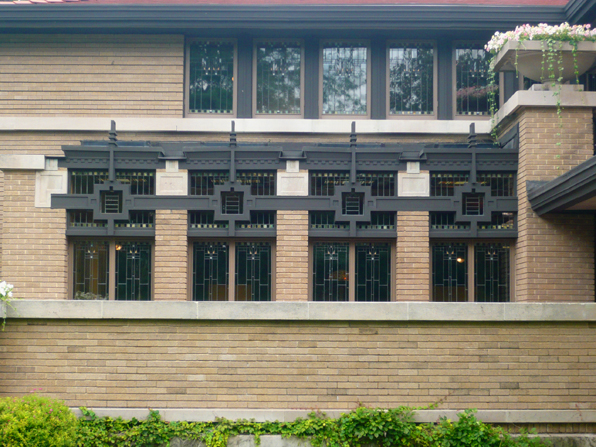
And, like in some many of Wright's houses built during this phase of his career, a complex and devoted attention to some rather fussy details like these Living Room windows.  One can't help but speculate that this heavy grille work on street-facing windows was as much defensive as decorative, a spill-over from Wright's domestic troubles, keeping the world at bay as much as providing light and views.  I have often thought that his growing predilection for the increasingly hidden and obscured entries of houses of his from this period are also an echo of the growing demand for privacy and avoidance of the public gaze that eventually surfaces in Wright's full retreat from Oak Park and Chicago to rural Spring Green, Wisconsin.

In any case, the Meyer May house is not only an excellent and under-appreciated work of Wright's from this period, it is also one of the very best examples of a period restoration that feels complete and careful without feeling like a museum (even though it is of sorts).  Steelcase purchased the home in 1985 and painstakingly restored the entire structure including sourcing many Wright-designed furniture and textile pieces to fill it.  And best of all and a great testament to the new owners, the house is fully available for tours for FREE, no reservations needed.  Thank you Steelcase for the great renovation and most importantly for allowing it to be viewed by anyone.
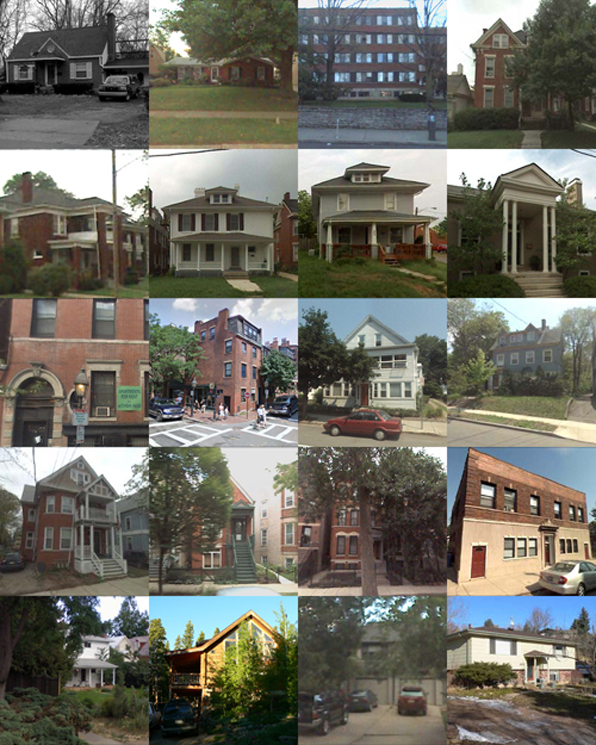
brick and sustainability - some places I've lived

Below is a series of photos of some of the places I have lived.  (Thanks to Google streetview for most of these).  Not everyplace is there – a house in Louisville when we first moved there, an apartment in Venice, a couple of places in Lexington, Kentucky – are missing. A question came up regarding masonry houses and the West.  Most everything built here in Colorado for single-family residential work is wood frame construction with wood siding, even though the environment out here is not kind to wood (too much high-altitude sun and snow).  I was wondering how common that was in other places and decided to take an albeit bias survey of a least the places I have lived.

Of the 20 places shown here, there are a couple of brick suburban houses in Louisville, KY; a brick dorm and some brick apartments in Lexington, KY; a couple of brick townhouses in Boston and a couple of brick houses in New Haven; some brick apartments and a converted storefront in Chicago.  The lower images are from Colorado:  a small frame house in Boulder, a log cabin in the mountains above Boulder, a wood-framed townhouse and then a partial brick suburban house in Boulder.

Maybe because I was obviously drawn to apartments in old, brick houses as a young adult, they’re heavily represented.  But overall, I think my experience is probably not that different from many others, moving from suburbs to cities and back to suburbs again.  It may be a regional expression or possibly a recognition of the age of building stock, but the paucity of masonry in the West is striking.  The number of older, quality buildings in Colorado is pretty thin, but this may not be the region as much as the relative youth of most of the buildings here.  I’m afraid in an society with increasing demands to make short-term capital, the idea of creating a building to last generations has simply died away.  Even the older, brick suburban houses that I grew up in Louisville have a solidity and permanence that a wood-frame and sided house can not invoke.  So I think looking at these images, it is not the region nor the suburban/urban/rural nature of the structure, but rather its date of construction that has most influenced the use of materials.  Hopefully with a  renewed interest in the environment, we can recognize that the most sustainable building is one that lasts the longest

on the boards, February 2011

Our workload has started off with a bang compared to the last couple of  years.  We are working on a number of really great projects - a couple of new houses, a couple of renovation/additions, a couple of master plans and a few other things.

As I mentioned in a previous post, a number of our new projects incorporate universal design principals for clients who are either current wheelchair users or anticipate reduced mobility over the next decade or so.

In light of the massive downturn in architectural services that we have all experienced over the last few years, it is thrilling to have the office full of drawings and models of ongoing work.  Along with our office picking up the pace, a number of previously unemployed architect-friends of mine are working again and contractors are no longer singing the blues as fervently as in past months.

It is quite a luxury to be selective about projects again, to engage in projects that are interesting and challenging and not necessarily all about paying the bills and keeping busy.  The recent upswing in inquiries has focused my desire to choose projects based on the site and the client, not the size or cost.  We'll see how they develop ... stay tuned.

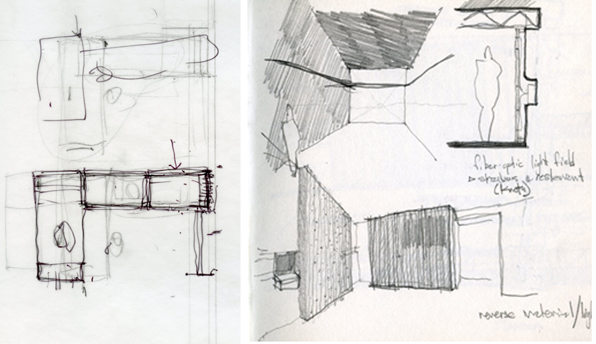
parti diagrams, part one

a parti diagram is an idea sketch, an initial response to a site, a client’s program or some other conditions that begin to determine the order for designing a project. They don’t really represent what the project will look like in plan or elevation, but are a road map of the ideas of the project. Ideas of ‘threshold’, ‘tension v. repose’, ‘horizon and center’, or ‘territory and enclosure’ all can be simply diagrammed in the parti as an initial response to the problem posed by a new project.

At Home by Bill Bryson

After waiting a number of weeks for a copy of At Home by Bill Bryson to make its way off the Holdshelf and into general circulation at the local library, I finally purchased a copy the other day.  I can fully admit to being completely fascinated by opinions, history and thoughts on what we all take for granted as a "house" as expressed by non-architects.  I  can't seem to stop buying books that give  a thoughtful point of view on the cultural edifice that is a house that are not written by architects, their magazines and especially the architectural academy. Bryson has written a number of books, most of whom I would classify as armchair travel lit.  In this case, the territory to be navigated is the house as conceived and formulated in Western Civilization over the last few hundred years.  The book's chapters are based on the rooms of a typical house - kitchen, dining room, etc. - and plumb the often odd history of the use of the room and its accompanying embellishments.  This kind of gentle deconstruction of the house, room by room, through history, is interesting even if it does, in its own form, reinforce the functionalist view of the house.

The most interesting section so far has been only a brief mention of an aspect of "house" design that I keep finding myself pondering over and is a subtext in a current project of mine.  In Renaissance villas and houses, the drawings rarely define rooms by their function.  Rather than labeling and defining a room for dining or a room for studying, a house is a collection of larger and smaller spaces.  The Italian word for furniture, mobili, gives us a clue about this lack of functional definition - furniture was meant to be mobile and so was one's occupation of the house.  Rooms were used for reading or sleeping or eating depending on the season and the time of day and the house was not a series of defined stage sets but rather a landscape to be traversed throughout the day and year.

"People moved around the house looking for shade or sunlight and often took their furniture with them, so rooms, when they were labeled at all, were generally marked mattina (for morning use) or sera (for afternoon)."

I admit that I have not yet finished the book, but I think I can recommend it to any one interested in what we mean by a house and how our patterns of using houses are embedded with a fascinating history.  I would especially recommend it to architects making residential projects as both an interesting read and a necessary perspective of the house from beyond the myopic view of the profession which tends to frame a house as merely a aesthetic object.