the map and the land

On a recent trip to the San Luis Valley, I took along a map, my phone's GPS, and a couple of satellite images.  From that elevated perspective, the Valley is a playground of geometry.  The large circles of center pivot irrigation fields overlays with the strict orthagonal grid of roads creating an ordered and rational allocation of property and access.
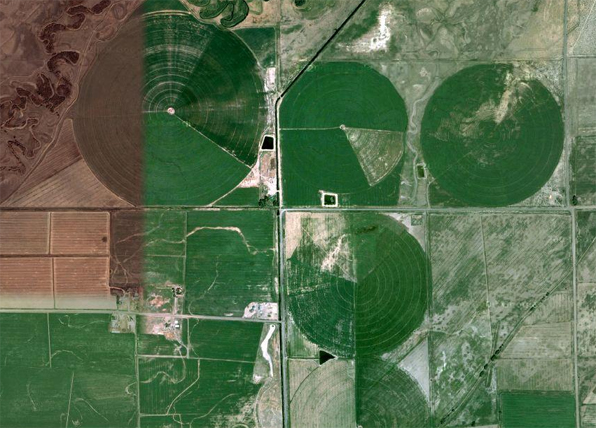
The image above, a satellite image, is split with two different seasons stitched together depicting the color and growth of irrigated fields - late fall on the left, spring on the right.

The map above shows the strict delineation of space in a grid, not unlike a typical city plan.

However, on the ground, things are much different.  It is almost impossible, especially at 65mph, to perceive the circular irrigated fields.  These figures, so dramatic from satellite images, are so large that the foreshortening of perspective makes their perception on the flat plane of the land almost impossible.
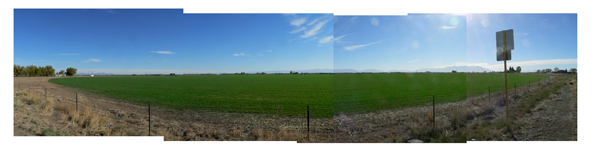
The same can be said for the grid of roads.  Driving the dusty gravel roads it is clear that almost every intersection is a four-way, 90 degree construction, but the overall impression of a large grid laid over the landscape is imperceptible.  A hint of this is found in the difference between the road map and the satellite image.  The image below is the same area as the gridded road map above.  So although the grid's east-west and north-south aspect ratio may remain consistent, the nature of the earth changes quite dramatically across the same territory.

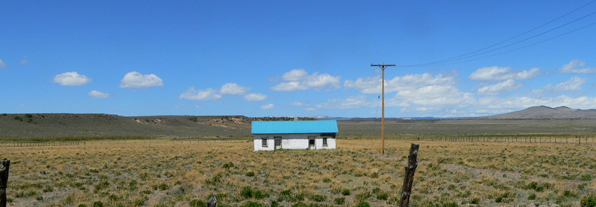
It is the very flatness of the land, surrounded by dramatic, snow-covered peaks, that so dominates your vision.  It is true that "map is not the territory" of course, but in this case the satellite image is not the same kind of abstraction as the road map.  The satellite image is a photograph of the reality, but so is the image below.

The map tells us where things are in relation to each other, but not how they are.  The satellite image fills that in a bit, but only a small bit.
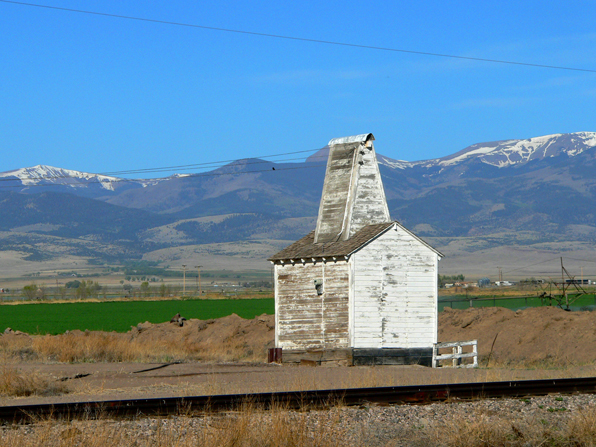
San Luis Valley

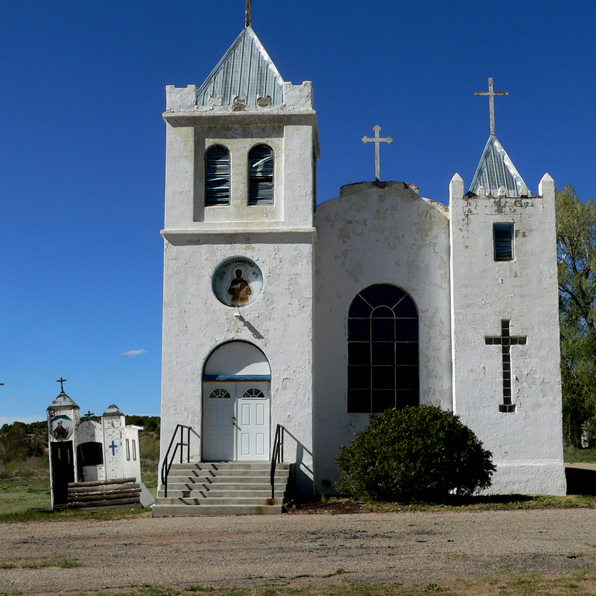
I recently returned from a windy and dust-caked trip to the San Luis Valley.  Inspired by a book by writer and photographer Robert Adams, The Architecture and Art of Early Hispanic Colorado, written in 1974, I drove through the small towns and even smaller hamlets in the southern San Luis Valley taking pictures, quaking in the sand-filled winds and feeling a rush for architecture and place that I have been sorely missing.

I have lots of photos, mainly of the variety and typologies of small chapels, including the remarkable roofless chapel in Las Mesitas.  Over the next couple of weeks I hope to do a little more research and post some of the images and some thoughts about this oldest of vernacular architecture in Colorado.

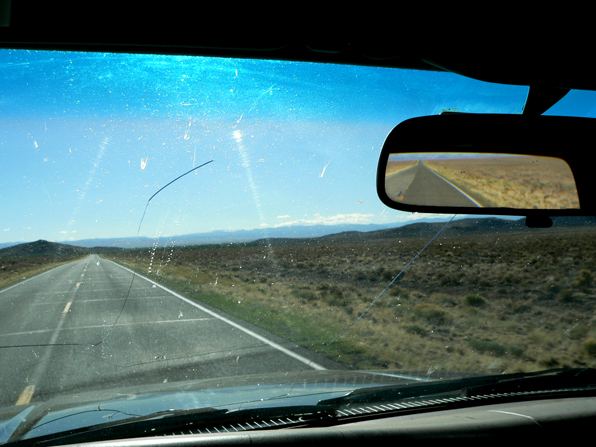
By the way, if you don't know how flat and relentless the central valley can be:

(I don't recommend this photo technique as you drive as you can't see at all where you're going.  Mind you, not a lot of traffic out there.)

what a house should be - part four - it should be fun

Architecture is serious business.  Not only because architect's take themselves painfully serious, but because for folks who choose to go down the path of designing and building a custom house, it is probably the most money they will ever spend.  Tends to be a bit sobering.

A house is the daily landscape of your life.  You wake up to the walls and ceilings, floors and doors, that are your house.  You go to sleep under the stars, but under that ceiling as well.  Your house ought to be fun.  I don't mean funhouse fun, although that can be done.  I mean that as much as we often endeavor to create a house that is a safe refuge in the world, it should also be a place of joy.  We don't have a lot of tools in our belts to pull this off as architects - the sun streaming in a window, the smell of blooming trees wafting through a kitchen, the solid satisfaction of a door closing.

A house can be whimsical.  We have all seen those crazy structures, hobbled together by some singular, driven, local wacko made of license plates or aluminum cans or auto tires.  But that ephemeral whimsy can be made of simpler stuff - a series of little ledges that hold glistening snow or scuppers that cascade the occasional shower.

A house made of only those things would be tiresome in short.  But without these little moments, designed lightly, a house is not much more than a big motel room without even the magnificently awful painting over the bed.

what your house should be - part three - it should be beautiful

This may seem obvious, but often people think they have to compromise between function and beauty.  They do not.  Any architect should be able to design a project that lives comfortable in that slippery neighborhood of "beautiful".  It may be that this is hopefully subjective, but many aspects of a kind of architectural aesthetics are not so elusive.

For most folks, the beauty of a building is what it looks like.  For most architects it is also what the building is.  Part of what makes a building beautiful is that it makes sense - the building is something, not simply an assembly of windows and doors, roofs and foundations.  For Modernist architects, the exterior of the building should reflect the uses of the interior - a kind of truthful transparency.  For more traditional architects, the exterior facades of the building don't necessarily have anything to do with the interior function, but they should be artfully composed.  In all cases, a kind of thoughtfulness comes through.  We may not all like a given building, but any well-designed building should be able to be appreciated as such.

Your house should be beautiful.  Maybe not cover-of-magazine spectacular, but it should be what architects call "resolved".  The proportions of  door and window openings should relate to each other, the masses of the building should work together, the trim and casing should reinforce the proportions of the openings.  This is not to say that every window or door is the same size.  That kind of consistency is boring and frankly lazy.  But every house ought to have been on hard enough and long enough to bring the design to a place where the building is something, not a pastiche of different styles or a thoughtless amalgam of parts. None of this is limited by budget.  Ever.  These things are the basics that every architect should be able to bring to bear on a project.  If they can't or aren't for some reason, find another.

Sunshine Canyon A-frames

I am working on a remodel and addition to an odd A-frame hybrid house at the base of Sunshine Canyon, just west of Boulder.  The original house, built in 1964, was designed by architect Richard Brown.  Brown designed a number of these modified A-frame houses, mostly around Boulder, before he later took that form and proceeded to design churches.

After a little research, I found an article in the Sunday Denver Post from May 10th, 1964, that shows another of these houses.  The article goes on to talk about the number of steeply-sloping building sites that were being constructed on in Boulder.  In an interesting and prescient harbinger of a kind of critical regionalism, the article, written by Ellen Bull, goes on to say,

"...in nine cases out of ten, Boulder house designers actually are determined by the terrain."

"among the assets which builders and architects emphasize are the many days of sunshine, both summer and winter, the mountain views, and the fact that the mountains are close enough to use and enjoy."

"As each builder or architect finds the answers to these questions, in his own individual way, he develops a building not quite like any other anywhere.  The very difficulties he faces stimulate his imagination and ingenuity."

Well said.  In 1964.  It is a shame more of the subsequent building in and around Boulder did not heed that advice as we have more than our share of suburban McMansion boxes awkwardly grafted onto steep mountain sites.

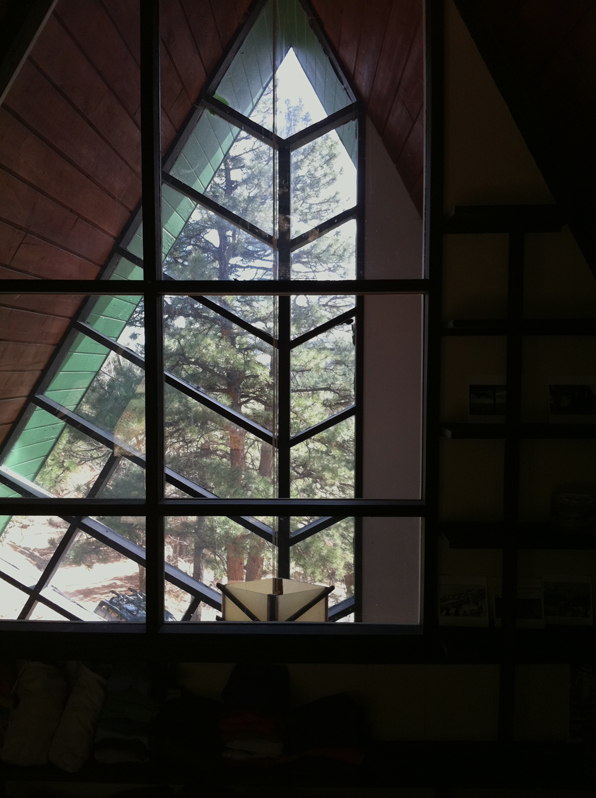
(window mullions reflecting the shape of the pine trees beyond)

Our work will be removing some of the interesting features of the house, but as the whole house is in such bad shape, we will see what can be saved and what we can echo in the new construction.