architecture

brick and sustainability - some places I've lived

Below is a series of photos of some of the places I have lived.  (Thanks to Google streetview for most of these).  Not everyplace is there – a house in Louisville when we first moved there, an apartment in Venice, a couple of places in Lexington, Kentucky – are missing. A question came up regarding masonry houses and the West.  Most everything built here in Colorado for single-family residential work is wood frame construction with wood siding, even though the environment out here is not kind to wood (too much high-altitude sun and snow).  I was wondering how common that was in other places and decided to take an albeit bias survey of a least the places I have lived.
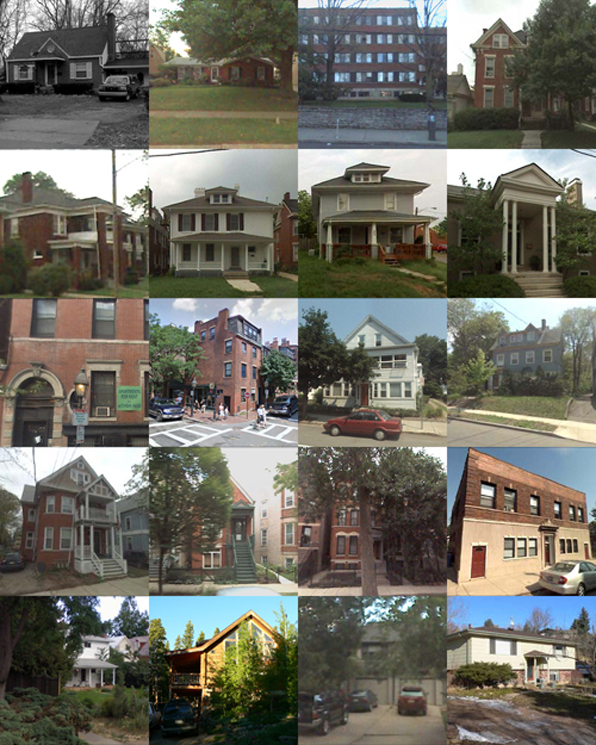
Of the 20 places shown here, there are a couple of brick suburban houses in Louisville, KY; a brick dorm and some brick apartments in Lexington, KY; a couple of brick townhouses in Boston and a couple of brick houses in New Haven; some brick apartments and a converted storefront in Chicago.  The lower images are from Colorado:  a small frame house in Boulder, a log cabin in the mountains above Boulder, a wood-framed townhouse and then a partial brick suburban house in Boulder.

Maybe because I was obviously drawn to apartments in old, brick houses as a young adult, they’re heavily represented.  But overall, I think my experience is probably not that different from many others, moving from suburbs to cities and back to suburbs again.  It may be a regional expression or possibly a recognition of the age of building stock, but the paucity of masonry in the West is striking.  The number of older, quality buildings in Colorado is pretty thin, but this may not be the region as much as the relative youth of most of the buildings here.  I’m afraid in an society with increasing demands to make short-term capital, the idea of creating a building to last generations has simply died away.  Even the older, brick suburban houses that I grew up in Louisville have a solidity and permanence that a wood-frame and sided house can not invoke.  So I think looking at these images, it is not the region nor the suburban/urban/rural nature of the structure, but rather its date of construction that has most influenced the use of materials.  Hopefully with a  renewed interest in the environment, we can recognize that the most sustainable building is one that lasts the longest

on the boards, February 2011

Our workload has started off with a bang compared to the last couple of  years.  We are working on a number of really great projects - a couple of new houses, a couple of renovation/additions, a couple of master plans and a few other things.

As I mentioned in a previous post, a number of our new projects incorporate universal design principals for clients who are either current wheelchair users or anticipate reduced mobility over the next decade or so.

In light of the massive downturn in architectural services that we have all experienced over the last few years, it is thrilling to have the office full of drawings and models of ongoing work.  Along with our office picking up the pace, a number of previously unemployed architect-friends of mine are working again and contractors are no longer singing the blues as fervently as in past months.

It is quite a luxury to be selective about projects again, to engage in projects that are interesting and challenging and not necessarily all about paying the bills and keeping busy.  The recent upswing in inquiries has focused my desire to choose projects based on the site and the client, not the size or cost.  We'll see how they develop ... stay tuned.

parti diagrams, part one

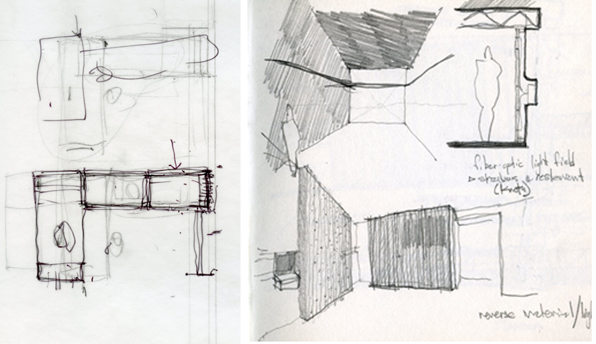
a parti diagram is an idea sketch, an initial response to a site, a client’s program or some other conditions that begin to determine the order for designing a project. They don’t really represent what the project will look like in plan or elevation, but are a road map of the ideas of the project. Ideas of ‘threshold’, ‘tension v. repose’, ‘horizon and center’, or ‘territory and enclosure’ all can be simply diagrammed in the parti as an initial response to the problem posed by a new project.

author-illustrator studio construction progress

We are making good progress on the construction of a new studio in Boulder, Colorado for a couple who are artists, illustrators and authors of children's books.

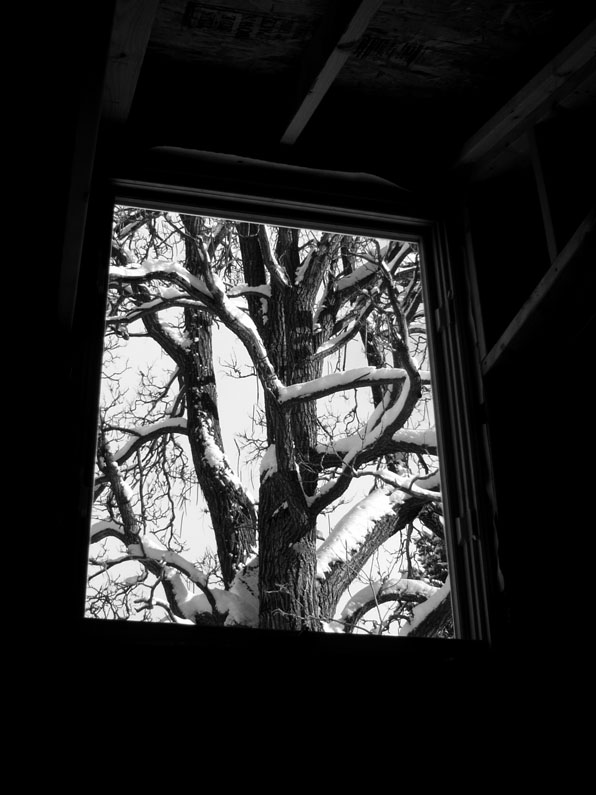
The project greatly increases the size of their existing studio and adds a second-level loft space.  The original studio was a dark, poorly-constructed structure and it was awkwardly attached to their 1880's Second Empire house.  Our new work involves creating a new studio that looks primarily to the west to take advantage of the deep space of their richly landscaped property.  The link to the old house is created by a small hall whose eastern face is pulled back from the older house's front porch to allow the old house to have a more complete expression.  This little reveal between the old and new is a small example of the project's attempt to create a positive dialogue between the old and new.  The studio's size and position required us to make a building that might "compete" with the older house.  Rather than fight with that formal issue, we used this potential problem as the central narrative for the project.

More updates to come as the construction progresses.

Builder:  Cottonwood Custom Builders

Mine the Gap - Late Entry

The Chicago Architectural Club ran a competition last year to elicit ideas about what to do with the ill-fated Chicago Spire project.  Our entry was never really considered for submission, but has been worked on and off since.

Designed by Santiago Calatrava, the Spire was to be the self-described "most significant residential development in the world". (go to the website to view the over-the-top video and especially the musical track).  It ran afoul of bad economic times and the Anglo Irish bank put a halt to the whole thing after only the gigantic 70' deep, 70' diameter foundation had been excavated alongside Lake Michigan on the eastern most edge of the city.  (in an amazingly myopic moment, Calatrava described his twisting design as an imaginary smoke signal coming from a campfire near the Chicago River lit by indigenous Native Americans.  An incredibly insulting and tone-deaf explanation that negates a couple hundred years of excellent Chicago architecture and is a lame attempt to justify a twisting, spiraling design that Calatrava has experimented with all over the globe.  As if genocide wasn't bad enough, lay off the native Americans already, don't implicate them in this placeless monstrosity.)

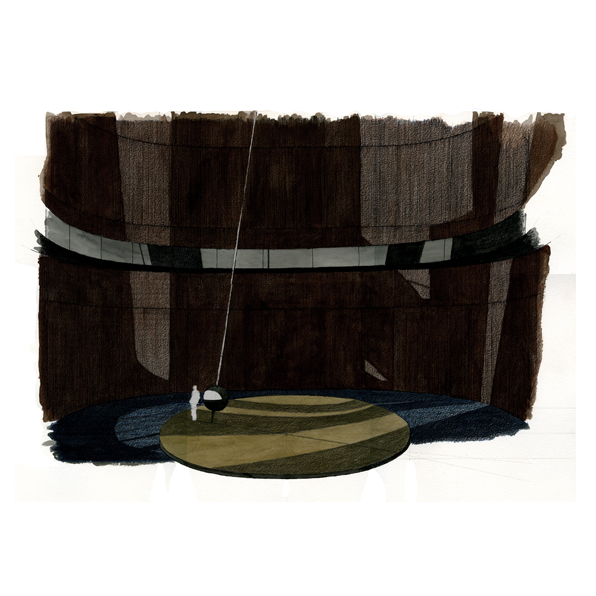
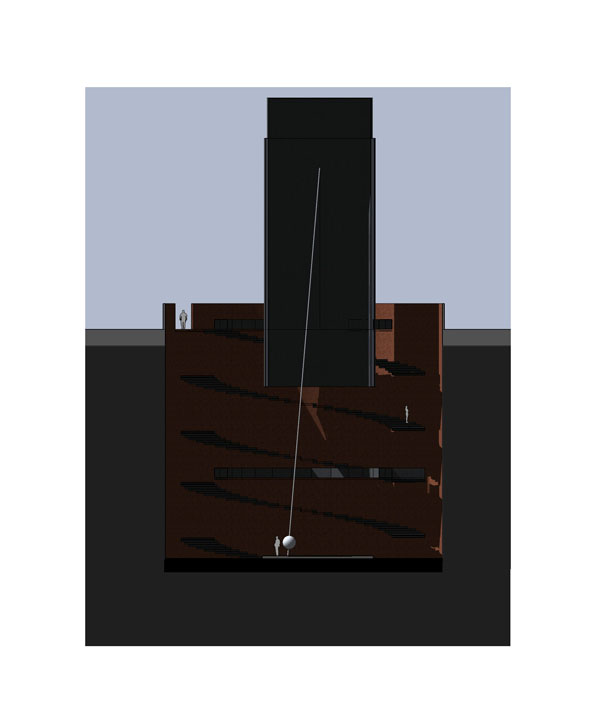
I can't help but see the hole as a grave dug by the recession to bury developer's hubris.  In light of that, our competition entry envisioned a slightly dystopic future for the site as an enormous time-keeper, with a Foucault pendulum slowly swinging away marking the passage of days until the whole reinforced foundation inevitably floods from below from seeping Lake Michigan.

Not a pretty building to cap an ugly incident in the city's history of over-reaching development.  Maybe we could have just filled up the hole with the demolished remains of the Cabrini Green housing project.

Hannah Barker house – preservation and perseverance

circa 1900

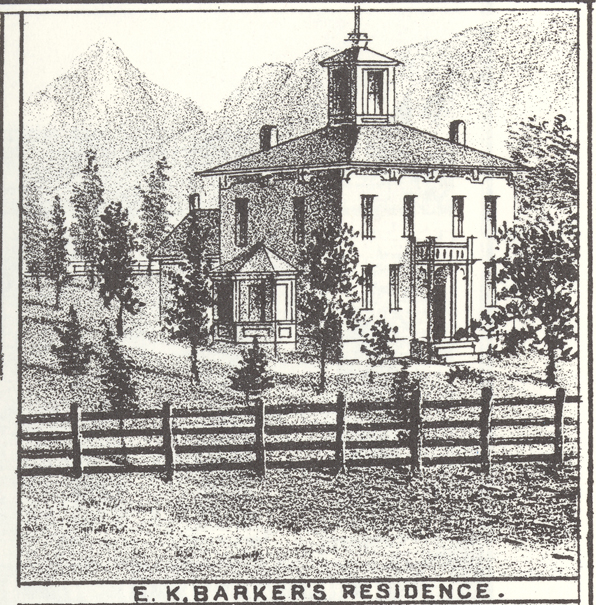
Yesterday Historic Boulder, our local non-profit preservation advocate organization, announced that it has purchased the long-unoccupied Hannah Barker house.  Most folks here in Boulder know it better as that dilapidated, boarded up white elephant on Arapahoe west of 9th Street.  Buying the house themselves certainly is a bold put-your-money-where-your-mouth-is move.  And it is not the first time.

today

Historic Boulder largely got its start in an effort in the early 1970's to save the threatened Boulder Theatre.  Rather than just picket the building and shout at some public hearings, they bought the building and secured it for a few years until a buyer could be found.  They have done similar purchase-to-perserve efforts since including the Highland Lawn School which has become the Highland City Club building.

1880 drawing

Sitting on the Landmarks Board, I hear a lot of complaining about the entire preservation process.  Maybe more than most places, in the West there is a strong owner's rights ethic that often runs smack into perservation efforts which attempts to protect our cultural heritage by primarily regulatory means. The recent success of Historic Boulder purchasing the Barker house mutes that conflict and lends immense credibility to the organization and the act of preservation in general.  And in the end, Historic Boulder will take the risk and the community will gain the benefit of a truly architecturally and historically significant building saved.

One of the most interesting aspects of this project will be Historic Boulder's intention to use the renovation of the house as a model for demonstrating that preservation, old houses and sustainability concerns can all work seamlessly together.  In Boulder we have a wealth of talented and experienced architects, builders, energy consultants and building science professionals that can be brought to bear on this project.

The building is currently a much-abused shell, but even in that state it has a tremendous amount of embodied energy that needs to be accounted for. Embodied energy is the all the energy inputs that the existing building represents - the energy required to lay the masonry, frame the house, and it also includes the trapped energy that was used in the creation of all those bricks and all that lumber, including its transportation.

Most energy conservation ordinances and programs do not give sufficient credit for embodied energy and rely more heavily on building systems and performance to meet sustainability goals.  Embodied energy is difficult to calculate, but only by carefully stepping through this process can we have a quantitative marker that proves "the greenest building is the one already there."

circa 1885

Hopefully a careful and exhaustively documented renovation process can convince the City of Boulder and other municipalities that they must included embodied energy as an integral part of their sustainability regulations and give it it's proper credit.  At that point, perservation and sustainability can be partners, not often contentious constituents.

Congratulations to Historic Boulder and all its volunteer members who made this possible, as well as the City of Boulder preservation and planning staff that aided in this much-needed process.

(All image from Historic Boulder and/or The Boulder Public Library, Carnegie Branch for Local History)